Zip screens · Growth
Zip screens: five years of growth in Ferrini’s shading range
This article is based on Ferrini’s 2015–2026 production records; figures are given as shares and indices only.
- Ferrini’s production records show the zip screen unit index rising from 100 to 421 between 2020 and 2025, the fastest growth among its shading products.
- Over the same five years the zip screen’s share of all units produced rose from 2.4% to 4.7%, and its motorised share from 54% to 98%.
- European sources point the same way: in Germany, screen production grew by 4% in 2025 [1].
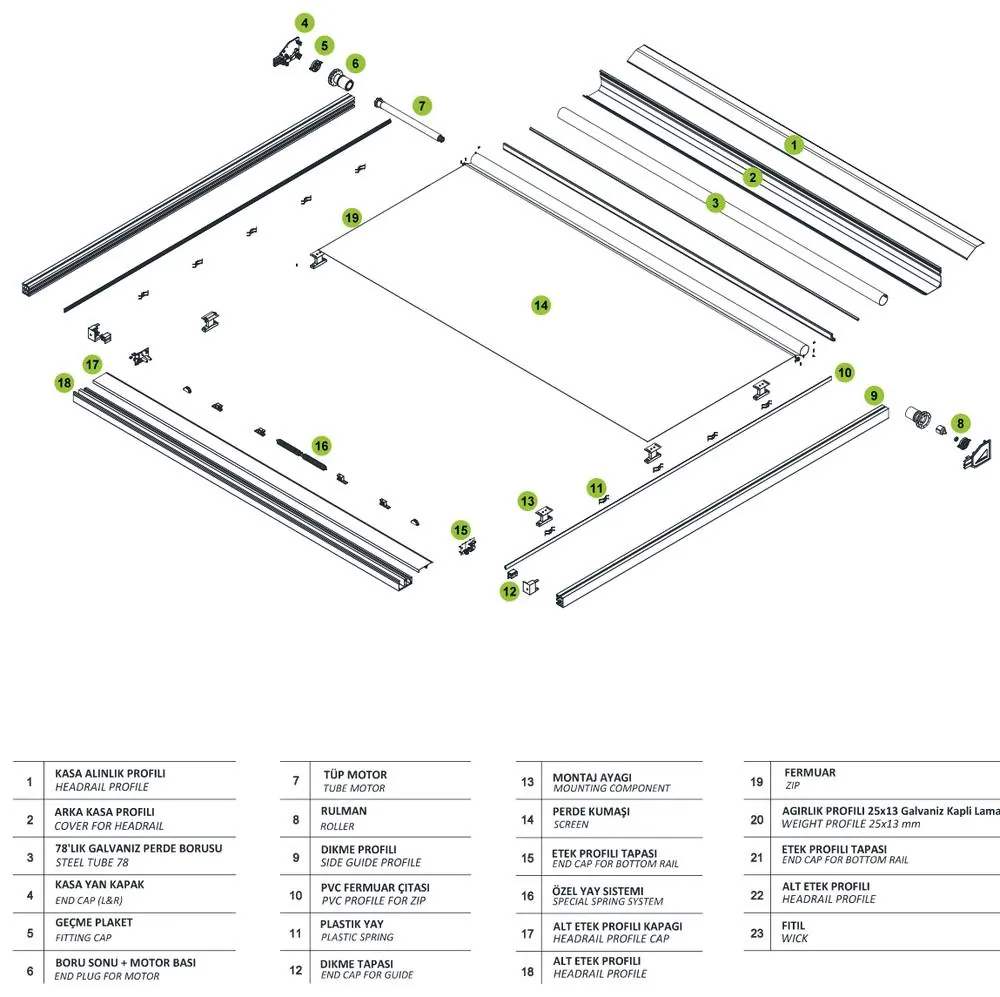
A zip screen is an external fabric blind whose side edges run in guide rails, held there by a zip-like strip. Because the fabric cannot pull out of the rails, it stays in place in the wind, and the product has become one of the most common shading solutions for terraces, glazed facades and winter gardens. Ferrini, which manufactures zip screens to measure in İzmir, took the product into regular production in 2020. This article sets out what its production, order and export records say about that growth, and which European market signals point in the same direction.
Growth in volume, value and motorisation
Measured in units, zip screen production rose from an index of 100 in 2020 to 421 in 2025, the product’s highest year to date. The product also changed in character during those five years. In 2020 the motor was still an option, fitted to 54% of zip screens; by 2025 it was fitted to 98%, so a manual zip screen is now the exception rather than the rule.
Value grew faster than volume. In 2025 the zip screen accounted for 11.7% of the value of Ferrini’s approved orders, well above its share of units, because a single zip screen is worth considerably more than a roller shutter. For a manufacturer whose range began with roller shutters, this gives a relatively small product family a large weight in the order book.
The lead product abroad
Ferrini’s approved orders show two different product mixes. At home, roller shutters lead; abroad, the zip screen comes first, and it is the product with which Ferrini is mainly known outside Türkiye.
The report therefore positions the zip screen as the lead product for exports, with roller shutters and glazed balcony systems as complementary products. At Fensterbau Frontale 2026 in Nuremberg, five of the eleven products on Ferrini’s stand were zip screens, among them a model fitted with a solar panel.
Signals from European markets
Among European manufacturers, product development for zip screens centres on two themes: wind resistance and integration with the facade [2, 3, 4]. In Germany, where the external solar shading market contracted in 2023 and 2024, screen production still rose by 4% in 2025 [5, 1].
In France, screens are moving from commercial buildings into housing [6]. More than half of French households have no air conditioning and most of them do not want to install it, while the RE2020 regulation is speeding up the adoption of motorised products [6].
Frequently asked questions
Where are zip screens typically used?
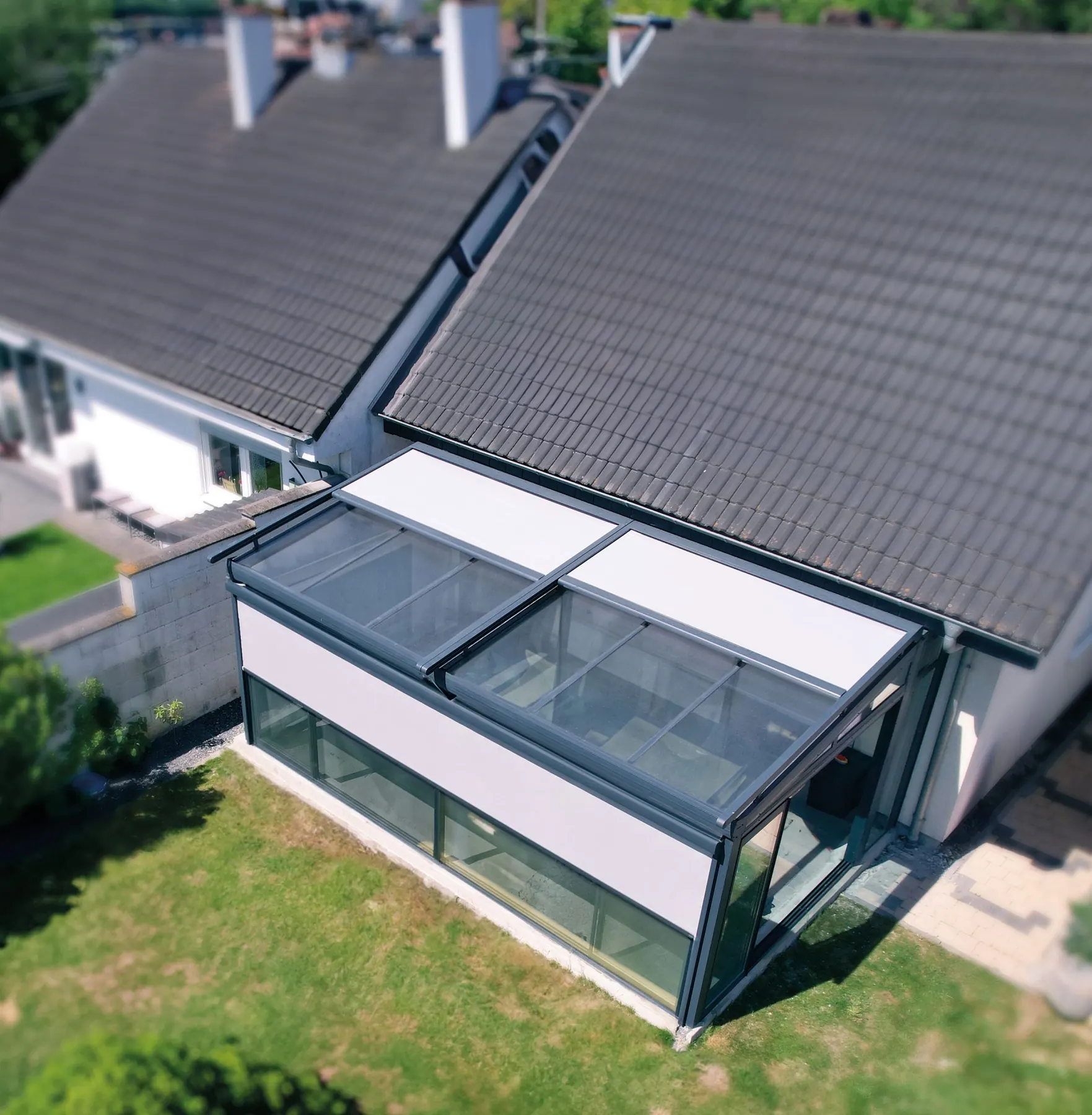
Mainly where an external blind has to cope with wind and large areas of glass: terraces, glazed facades and winter gardens. Vertical screens in front of windows and glass walls make up most of the family, while roof screens are fitted over terraces and winter gardens. Because the screen cuts solar heat while the outlook is kept, it is often chosen for glazed elevations.
How seasonal is zip screen demand?
Strongly. In Ferrini’s production, about a quarter of annual zip screen units are made in June and July, and July is the peak month. Demand for sun-related products starts with the first hot days, so the report concludes that stock and installation capacity need to be in place by May. Windows and glazed balconies peak towards December, which helps a mixed range balance production through the year.
Sources
- Baulinks, Sonnenschutzmarkt (Branchenradar 2025 summary), 21 April 2026, accessed 02.10.2026. https://www.baulinks.de/sonnenschutz/sonnenschutzmarkt.php
- Renson, Fixscreen 100 product page, undated page, accessed 02.10.2026. https://www.renson.eu/es-es/producten-zoeken/zonwering/screens/fixscreen/fixscreen-100
- ROMA KG, Wenn der Sonnenschutz mit der Pfosten-Riegel-Fassade verschmilzt: ROMA zipSCREEN F50 (press release), 12.10.2021. https://api.roma.de/presse/wenn-der-sonnenschutz-mit-der-pfosten-riegel-fassade-verschmilzt-roma-zipscreen-f50/55602/20211012_ROMA_KG_Presseinformation_zipSCREEN_F50_final.pdf
- Ediltecnico, Gibus S.p.A. firma profili, undated page, accessed 02.10.2026. https://ediltecnico.it/aziende/gibus-spa
- Baulinks, Außenliegender Sonnenschutz verlor 2024 weitere 12% Umsatz in Deutschland (Branchenradar), 23 June 2025, accessed 02.10.2026. https://www.baulinks.de/webplugin/2025/0837.php4
- Batiweb, TBC Innovations publie une étude sur les marchés des protections solaires en France, 17 February 2025, accessed 02.10.2026. https://www.batiweb.com/actualites/etude/tbc-innovations-publie-une-etude-sur-les-marches-des-protections-solaires-en-france-45922